

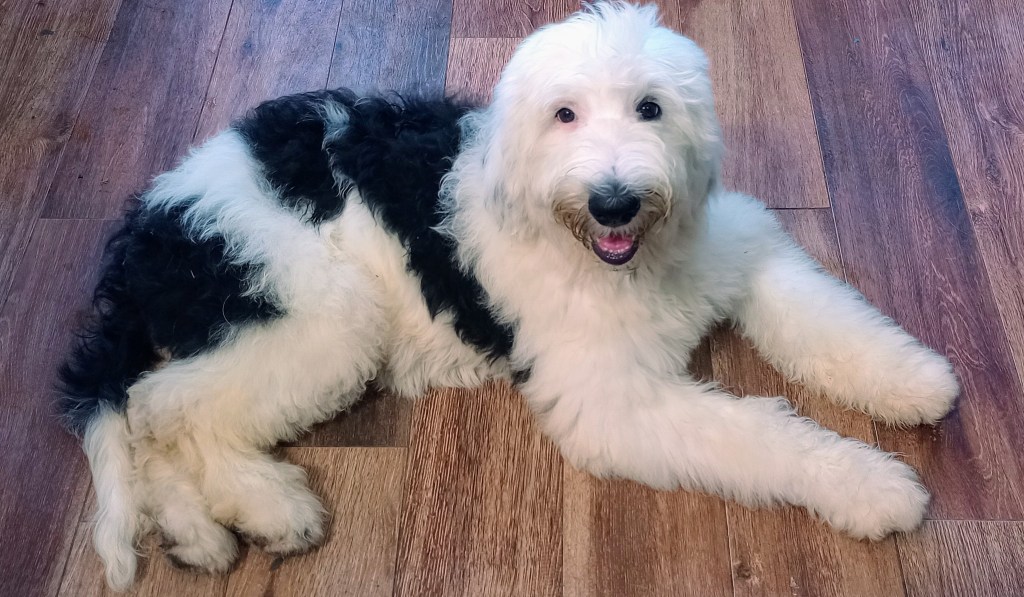
Lyric is one of two pups from this litter that I chose to raise as a future Service Dog. Her handler has not yet been identified. If you are considering employing a fully trained Service Dog to help mitigate your disability, please feel free to CONTACT us.
“Sit, Shake & Follow”
Although we’ve retained Lyric to train as a Service Dog, all the beginning “training” shown in these short clips is really very early in a pup’s career because, well, Lyric is just a wee pup. I reward her for anything close to what I hope to see as a truly formed behavior in the future because I want her to want to learn and interact. I’m not worried about “repeating commands” or rewarding the wrong behavior. I can fix that very easily by simply refusing to reward the unwanted / additional behavior at some point in the future. I think she’s doing great.
Natural Retrieving
When a pup shows an interest in retrieving, I always make it a big deal. It’s a behavior that I really want to develop because it can be employed in so many application from just basic fun sport, to critically important work for a Service Dog.
Circle
Teaching a pup to follow a lure (even a hand holding a treat) can be used to form other, useful behaviors. The “Circle” command often becomes a signal that the Service Dog has detected something like a low or high blood sugar value/scent for a person with diabetes.
Shake Paw – Double Shake
The “Shake Paw” behavior can be used as a parlor trick for companion dog, but for Service Dogs it can be morphed into a number of useful tasks. Most of the puppies in Lyric’s litter began presenting a natural presentation of their paw very early and I simply captured it by rewarding the behavior with a treat. Some pups prefer to present one (left or right) paw, and others are quite ambidextrous – switching between paws at will. Those pups are easy to coax into performing a “Paw’s Up behavior.
Paws Up
A very commonly requested Service Dog task is “Paws Up.” On command, the dog places his feet in the lap of the handler. Folk whose disability is mitigated through “deep pressure” find the dog’s weight and presence to be helpful in reducing their medical conditions (these include clinical anxiety, PTSD, and sometimes aspects of Autism.) This “on command” task can become an autonomous response behavior to the handler’s “shift from normal” once the dog learns that he’s requested to perform the behavior under specific circumstances that, with time, the dog often learns to predict.
Sometimes things go better than expected, like in this next clip. Lyric was crated in the room when I was working with one of her siblings on “Paws Up.” Could she really have assimilated the behavior through observation?
Come
We teach a reliable, “because I said so” to all Service Dogs when they are old enough to understand the concept of absolute obedience. Until then, we introduce the word and reward the behavior.
I am having so much fun working with Lyric. She’s a special pup and I can’t wait to find out how her future unfolds.

 INTENTION CANINE
Leave a comment